Open Access Article
Read the published paper from the companion page.
The article is open access under a CC BY license. The DOI remains the canonical citation and access point; the embedded PDF is provided for convenient reading.
Research companion for Godlewski and Olszak (2025)
How European macroprudential tightening changes syndicated loan contracts: larger facilities, more collateral, and a shift in how banks manage credit risk.
Question
Macroprudential tools are usually evaluated through aggregate credit growth, bank risk, or financial stability. This paper moves the lens down to the loan contract and asks whether regulation changes loan amount, maturity, collateral, and covenant use.
Banks facing tighter macroprudential policy do not only lend less or more; they lend differently.
Tightening is associated with larger syndicated facilities.
Tightening raises the probability that loans are secured.
The paper finds no systematic baseline effect on these two margins.
Literature Map
The companion site redraws the PowerPoint network as a cleaner reading guide. Prior work studies credit cycles, bank risk-taking, and bank performance. The paper connects those channels to the microstructure of syndicated loan contracts.
Macroprudential tools and aggregate credit dynamics.
Regulation, bank balance sheets, and risk-taking incentives.
Contract-level evidence on syndicated loan amount, maturity, collateral, and covenants.
How regulatory pressure interacts with funding costs, capitalization, and intermediation margins.
Loan terms as risk-allocation tools between borrowers and lenders.
Data And Design
The empirical design combines macroprudential policy actions with syndicated loan contracts. Policy exposure is assigned through the country of the lead arranging bank and lagged by one year relative to loan origination.
ECB MaPPED records tightening, loosening, and other macroprudential actions.
Actions are aggregated into net MPI, tightening, loosening, and instrument-specific measures.
Bloomberg syndicated loan data provide amount, maturity, collateral, covenants, and syndicate details.
Regressions estimate whether policy stance changes the terms written into new loans.
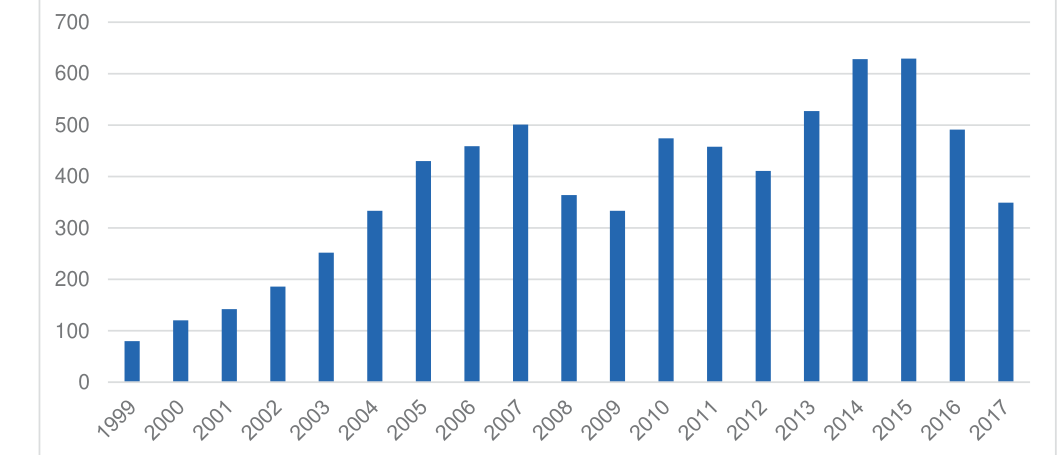
Sample timing: syndicated loan originations by year. Source: authors' figure from the article.
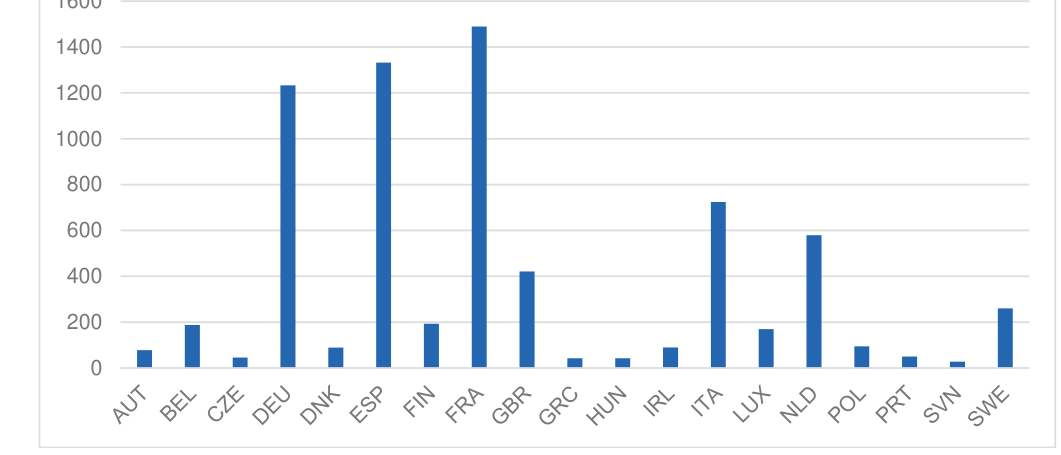
European coverage: loans by borrower country. Source: authors' figure from the article.
Main Evidence
The baseline results support the intensive-margin interpretation. A one-standard-deviation increase in macroprudential tightening is associated with about USD 57 million more per facility and about 5.4 percentage points higher secured-loan probability.
Loan amounts rise under tighter macroprudential conditions.
Banks strengthen contractual security when regulation tightens.
The baseline estimates do not show a systematic maturity response.
Covenants remain a less central adjustment margin in the baseline results.

Tighter policy can push banks toward safer exposures and stronger contractual protection.
Banks may preserve lending activity by scaling up secured loans rather than uniformly cutting credit.
The adjustment favors borrowers able to absorb larger facilities and pledge collateral.
Where Effects Are Strongest
The paper's heterogeneity tests clarify the mechanism. The main pattern is concentrated in settings where banks can reallocate credit toward secured, larger, and more manageable exposures.
The positive amount and collateral effects are clearer when lead arrangers and borrowers operate in the same country.
Capital-based and borrower-targeted instruments are the policy categories most closely tied to contract redesign.
Larger or more leveraged borrowers and well-capitalized arranging banks are central to the observed response.
Policy Variation
The MaPPED-based policy index supplies the identifying variation. The figures below show average macroprudential policy stance by year and by lead-lender country.
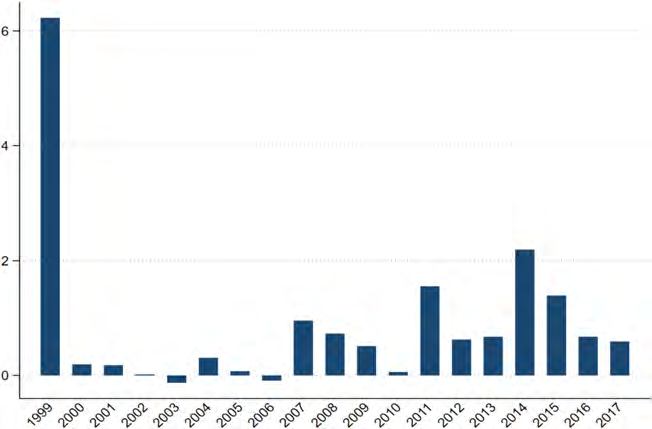
Macroprudential policy index by year. Source: authors' figure from the article.
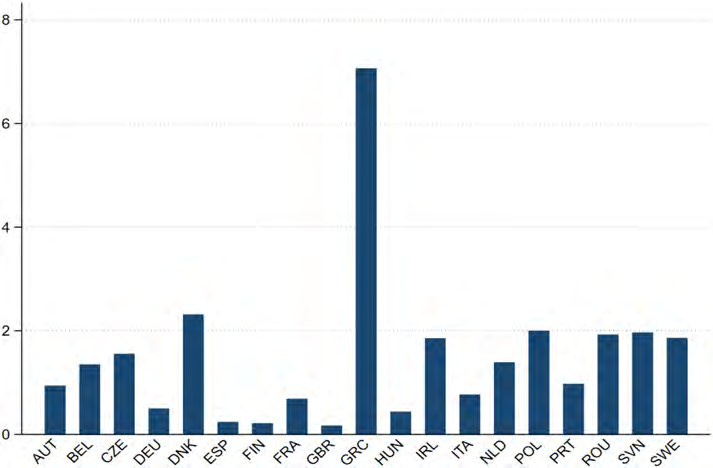
Macroprudential policy index by lead-lender country. Source: authors' figure from the article.
Open Access Article
The article is open access under a CC BY license. The DOI remains the canonical citation and access point; the embedded PDF is provided for convenient reading.
Citation
This companion page summarizes the published article and points readers to the canonical journal DOI. Numerical claims are drawn from the article text and tables.
@article{GodlewskiOlszak2025MacroprudentialLoans,
  title   = {Macroprudential policy and corporate loans: evidence from the syndicated loan market},
  author  = {Godlewski, Christophe J. and Olszak, Malgorzata},
  journal = {Journal of International Financial Markets, Institutions & Money},
  volume  = {104},
  pages   = {102223},
  year    = {2025},
  doi     = {10.1016/j.intfin.2025.102223}
}